New study: Antarctic krill adapt their feeding to changing food availability in the eastern Weddell Gyre
November 10th, 2026
New research reveals how Antarctic krill feed opportunistically on the most readily available food sources, highlighting the important influence of sea-ice conditions on Southern Ocean ecosystems.
Antarctic krill are among the most important species in the Southern Ocean. They play a central role in marine food webs, providing a major food source for whales, seals, penguins and seabirds. Amazingly, the total biomass of Antarctic krill is seven times as high as that of all wild mammals on Earth combined.
The survival of krill depends on the availability of food, which is closely linked to seasonal changes in sea ice algae and phytoplankton production.
But how do Antarctic krill adapt their feeding when food sources vary across different regions of the Southern Ocean?
In a new study, an international team* led by Sebastien Moreau and including PhD student Megan Lenss, both from the iC3 Polar Research Hub, investigates the feeding habits of Antarctic krill in the Kong Håkon VII Sea, in the eastern Weddell Gyre. The research examines the relative contributions of two major food sources: phytoplankton growing in the water column and algae living within sea ice inclusions.
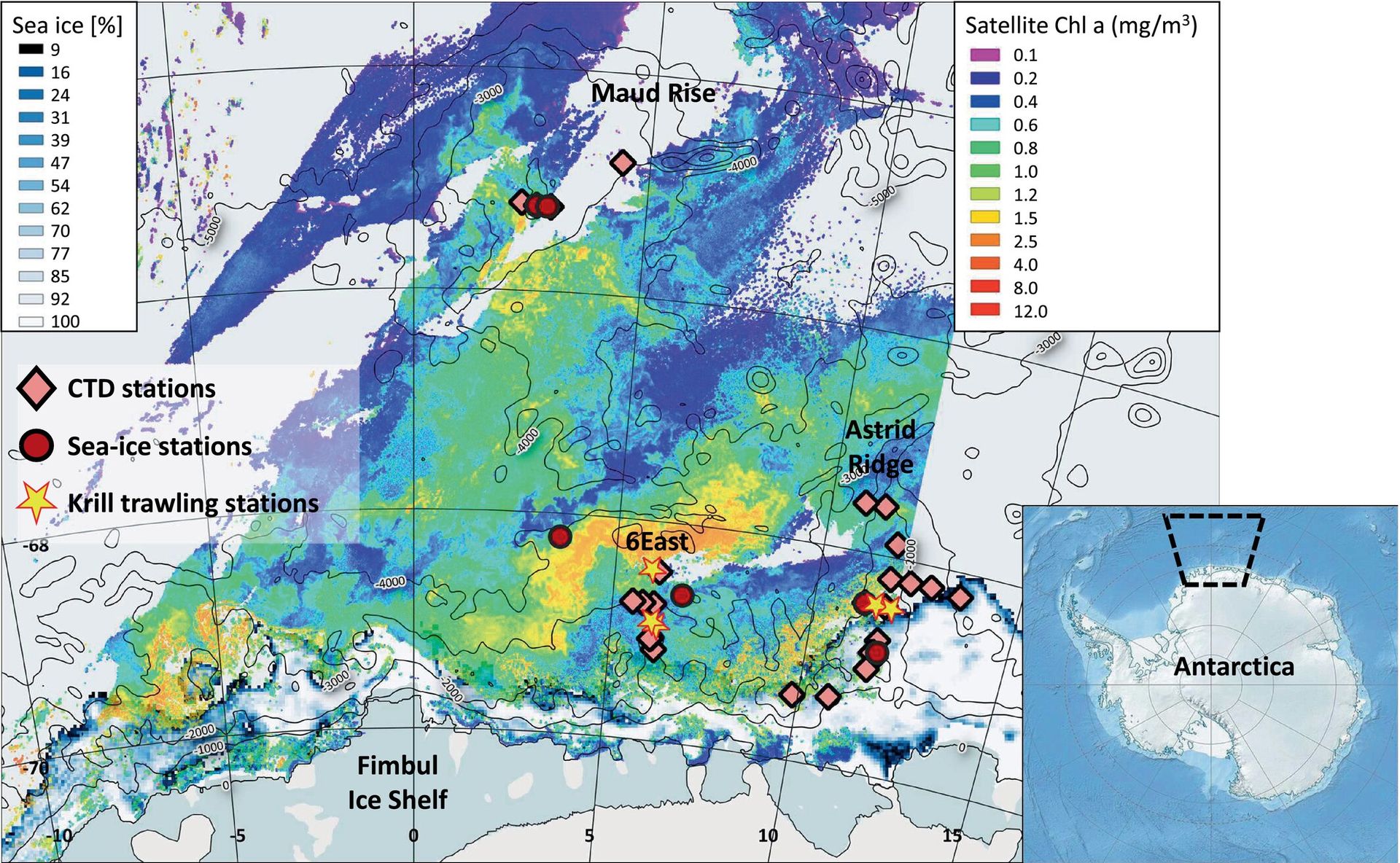
Figure: Map of the study area in the Kong Håkon VII Sea, in the eastern Weddell Gyre, Antarctica. Credit: Moreau et al., (2026), Limnology and Oceanography.
Following the food sources
The researchers collected samples during a research cruise in March 2019, investigating three different areas.
By analysing the stable carbon and nitrogen isotope compositions of krill and particulate organic matter from the water column and the sea ice, the team could investigate where the krill's food originated and how their diets differed between regions.
The results revealed clear geographical differences.
At Astrid Ridge, where sea-ice cover was more extensive, both phytoplankton and krill showed higher carbon isotope values. This suggests that ice-associated algae contributed to the development of phytoplankton communities in the water column, potentially through the release of algae from melting sea ice.
In contrast, at Maud Rise and along a transect following 6° East, the isotope signatures indicated a more limited influence of sea-ice algae on the available food sources.
Despite these regional differences, the researchers found no significant differences in the feeding signatures between juvenile and adult krill, or between males and females.
This suggests that krill at different life stages feed opportunistically on the most abundant food sources available in their surroundings. This was particularly important at the time of the study, autumn, when krill need to store reserves for the upcoming long Antarctic winter.

Picture: Antarctic krill. Credit: Rudy Caeyers (UiT).
Flexibility in a changing Southern Ocean
Sebastien Moreau, iC3 researcher and lead author of the study, concludes:
"Our results show that Antarctic krill can make use of different food sources depending on what is available locally. The connection between sea ice, phytoplankton and krill is therefore important for understanding how changes in sea-ice conditions may affect the Southern Ocean food web."
The findings highlight the flexibility of Antarctic krill feeding strategies, which may help the species cope with changing environmental conditions. However, ongoing climate change is altering sea-ice extent and duration across the Southern Ocean, with potential consequences for the abundance and composition of phytoplankton and ice algae communities.
Understanding how krill respond to these changes is essential for assessing the future of Southern Ocean ecosystems and the many species that depend on them.
.
Find out more
The study “Opportunistic feeding by Antarctic krill in the eastern Weddell Gyre”, is published open access in Limnology and Oceanography (2026).
Lead author Sebastien Moreau is a researcher at the iC3 Polar Research Hub based at the Norwegian Polar Institute in Tromsø, Norway. Within iC3, he is the assistant research lead of the Research Unit 3: Ice sheets and the oceans where he studies the consequences of the melting cryosphere (ice sheet retreat, icebergs and sea ice) on polar marine ecosystems. To find out more about his research on polar phytoplankton and biogeochemistry, check out his website, read his interview, or contact him by email.
Co-author Megan Lenss is a PhD student with the Norwegian Polar Institute and UiT’s Department of Arctic and Marine Biology. Within iC3, she is part Research Unit 3: Ice sheets and the oceans. To find out more about her work, read her interview, or contact her by email or via LinkedIn.
*The international team included researchers Hanna Kauko and Anette Wold from the Norwegian Polar institute (NPI, Norway), Tone Falkenhaug from the Institute of Marine Research (IMR, Norway), Hauke Flores and Doreen Kohlbach from the Alfred-Wegner Institute (AWI, Germany), Katrin Schmidt from the University of Plymouth (UK), Magdalena Różańska-Pluta and Jozef Wiktor from the Institute of Oceanology Polish Academy of Sciences (IOPAN, Poland), and Philippe Claeys from the Vrije Universiteit Brussel (VUB, Belgium).