New study provides evidence of Arctic Ocean isolation from the North Atlantic during two past glaciations
November 19th, 2026
During several past cool periods in the Earth's history, the Arctic Ocean may have experienced conditions very different from those we see today. As massive ice sheets expanded across the Northern Hemisphere, ice shelves may have grown over large parts of the Arctic Ocean and Nordic Seas, reaching the seafloor in some areas and blocking the ocean gateways connecting the region to the North Atlantic.
Scientific disputes over oceans of the past
Scientists have long debated whether the «Arctic Mediterranean», comprising the Arctic Ocean and Nordic Seas, was genuinely isolated from the North Atlantic during these glacial periods. If so, the absence of Atlantic water inflow would have allowed gradual freshening of the deep basins.
However, an alternative explanation suggests that previously identified unusual geochemical signals in marine sediments could instead result from changes in sediment accumulation, rather than from changes in ocean circulation.
Distinguishing between these explanations is essential to understanding whether the Arctic Mediterranean experienced episodes of isolation and freshwater accumulation during past Pleistocene glaciations.
New evidence from iC3 researchers
New research, led by Agathe Ollive from the iC3-affiliated Into the Blue project, now provides geochemical evidence supporting the isolation hypothesis.
By applying a geochemical approach that is less sensitive to changes in sediment accumulation, the researchers provide an independent test of this long-debated hypothesis and strengthen the evidence for freshwater accumulation in the isolated basin.
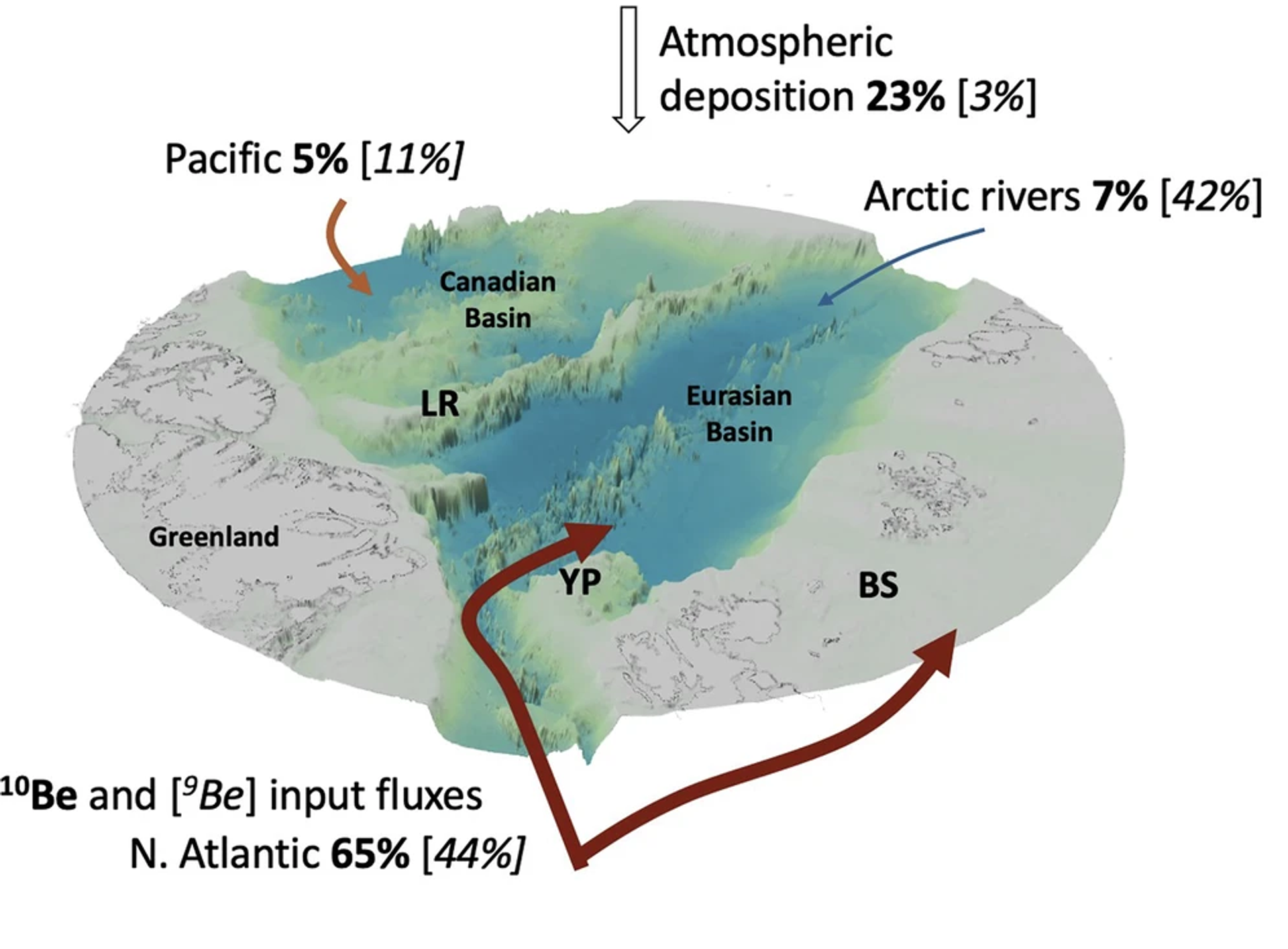
Figure: Conceptual Arctic Ocean 10Be (in bold) and 9Be (in brackets) budgets under interglacial/modern-like conditions. Credit: Ollive et al. (2026), Nature Comms Earth Env.
Looking for evidence in marine sediments
To investigate the «Arctic Mediterranean» isolation hypothesis, the research team analysed beryllium isotopes preserved in marine sediment cores collected from the Arctic Ocean, Nordic Seas and North Atlantic.
In particular, the team - which also included iC3 researcher Henry Patton - examined the ratio between two isotopes, beryllium-10 and beryllium-9. This ratio provides information about the origin of water masses and can help distinguish between Atlantic-derived waters and freshwater inputs from Arctic rivers.
Evidence of repeated isolation
The results reveal consistently very low beryllium ratios in sediment layers corresponding to past glacial periods. These values were more than an order of magnitude lower than those found in coeval North Atlantic waters– supporting the absence of a North Atlantic signal.
Importantly, the pattern was observed across different Arctic basins and sediment cores, despite differences in sedimentation rates and sediment sources. This suggests that the signal reflects changes in water-mass circulation rather than simply variations in sediment accumulation.
The findings provide strong evidence that the Arctic Mediterranean was disconnected from the North Atlantic during two glacial periods: approximately 150,000 to 130,000 years before present (Marine Isotope Stage 6, or MIS 6) and 70,000 to 62,000 years before present (MIS 4).
During these intervals, the absence of Atlantic inflow would have allowed the freshening of the waters. Previous estimates suggest that this dilution could have occurred in less than 10,000 years.
Agathe Ollive, member of the iC3-affiliated project into The Blue (i2B) and lead author of the study, says:
“What makes these findings particularly interesting is that we can now distinguish changes in ocean circulation from changes in sedimentation. This gives us stronger evidence that the Arctic Mediterranean presented a peculiar geochemistry and was genuinely isolated from the North Atlantic during these glacial periods, with potentially important consequences for ocean circulation and climate.”
Abrupt climate changes?
These results offer new insights into how ice sheets and ocean circulation interacted during past glaciations.
They also raise important questions about what happened when the ice barriers eventually retreated and the connection with the North Atlantic was restored. Could the release of large volumes of accumulated freshwater have affected the Atlantic Meridonial Overturning Circulation (AMOC) and contributed to abrupt climate changes?
Understanding these past interactions is important for assessing how polar ocean systems will respond to future major changes in ice cover.
Find out more
The study “Episodic isolation of the Arctic Mediterranean from the North Atlantic during late Pleistocene glacials” is published open access in Nature Communications Earth & Environment.
Lead author Agathe Ollive is a postdoc researcher working with the into The Blue (i2B) project, affiliated with iC3, and based in the Department of Geosciences at UiT The Arctic University of Norway, Tromsø. The present study formed part of her PhD thesis at the Alfred Wegner Institute. To find out more about her work, check out her list of publications, contact her by email or via LinkedIn.
Co-author Henry Patton is a researcher working on carbon storage in subglacial sedimentary basins, based in the Department of Geosciences at UiT. To find out more about his work, please check out his interview, his list of publications, or contact him by email.