Hidden under the ice: why Antarctic sea-ice algae matter more than you think
December 10th, 2025
A new study led by Megan Lenss, a PhD researcher affiliated with the iC3 Polar Research Hub, uncovers new insights into microscopic organisms that are vital for life in the seas off Antarctica and natural carbon dioxide uptake worldwide.
Tiny algae growing under the sea ice of Antarctica might not seem like a big deal. But where these algae live, and what could happen to them as the sea ice melts away, is a big part of the story of life on Earth.
Megan’s findings shed light on one of the most productive and least understood habitats on the planet. They also hint at how climate change could threaten the very foundation of Antarctica’s marine food web.
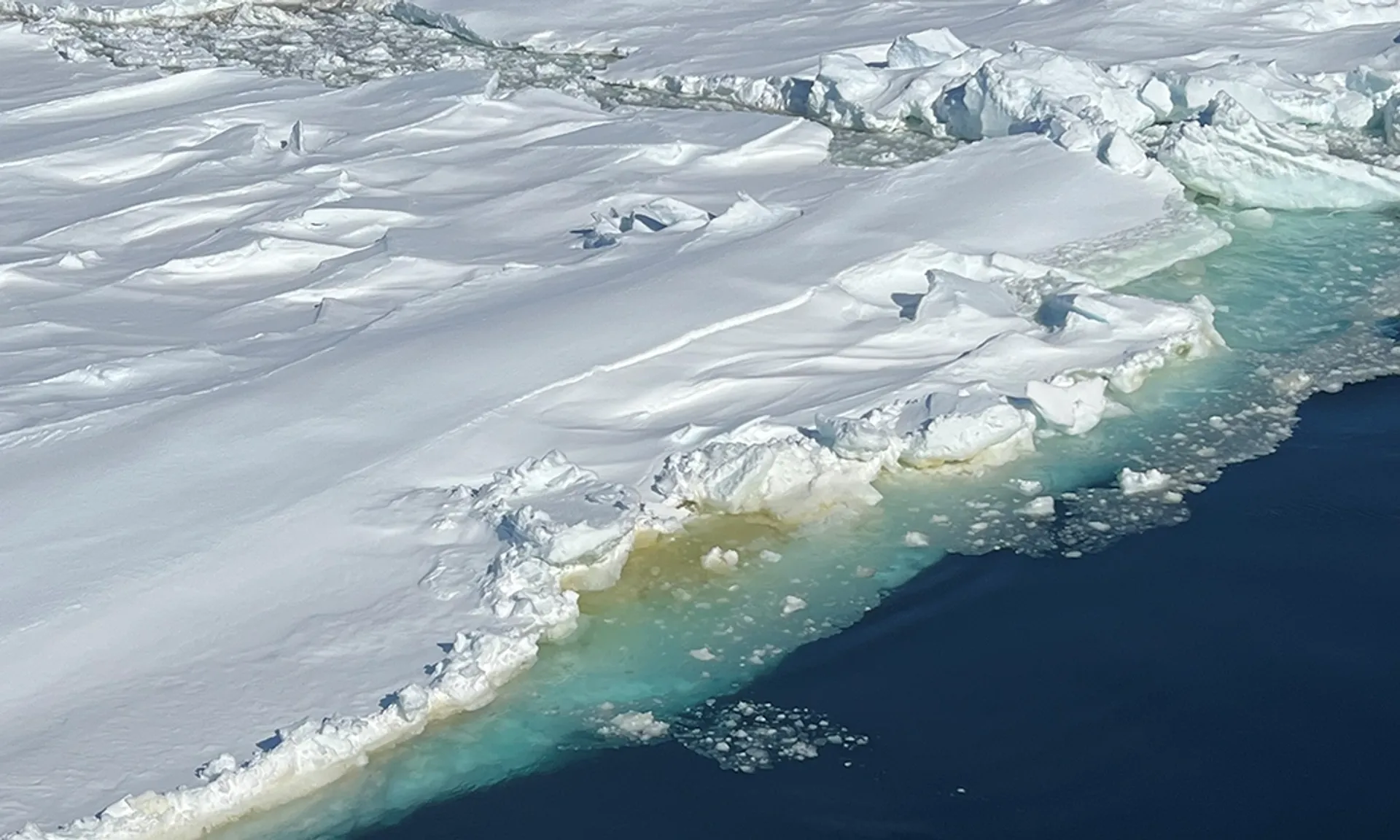
Picture: Algae discovery at the ice edge. Credit: Megan Lenss.
What’s hiding in the ice?
Megan’s research focuses on a special kind of sea ice called "platelet ice". This forms when supercooled water beneath Antarctic ice shelves creates floating crystals. Over time, these crystals rise, grow, and clump together, forming a loose, sponge-like layer under the sea ice.
“It’s the most productive sea-ice environment ever recorded,” Megan says. “There can be up to a whole magnitude more carbon in the platelet ice layer than anywhere else in the sea ice.”
This productivity comes from sea-ice algae. These microscopic algae thrive in the briny channels and pores inside the ice. When platelet ice becomes incorporated into the solid sea ice, it creates a unique habitat—roomy and full of nutrients—that sea-ice algae love.
Megan and her co-authors analysed sea-ice cores collected during a cruise to the King Haakon VII Sea off Antarctica.

Credit: Sebastien Moreau (NPI & iC3)
“Every single sea-ice core we sampled had a nice big layer of incorporated platelet ice,” Megan says. “That is the first time this is recorded in this region of the Southern Ocean. We knew it was probably there, but it has never been published before.”
A refuge for algae?
The timing of the sampling turned out to be especially important. It took place very late in the summer season, when most of the sea ice had already melted. “What we sampled was of the last sea-ice present,” Megan explains. “And we still find fairly high chlorophyll a concentrations—indicating an ice algal bloom.”
This led the team to propose a bold idea: that this kind of sea ice might represent the last viable microhabitat for sea-ice algae at the end of the summer melt.
“If you're really making some leaps,” Megan says, “you might be able to say that the algal bloom follows a kind of textural succession—maybe it grows in all textures at first, and then later it’s only found in these layers of incorporated platelet ice.”
And as the Southern Ocean warms, she adds, this kind of habitat might become increasingly important: “If summer conditions become more prevalent and happen earlier, this could become one of the last spaces still harbouring a strong algal bloom.”
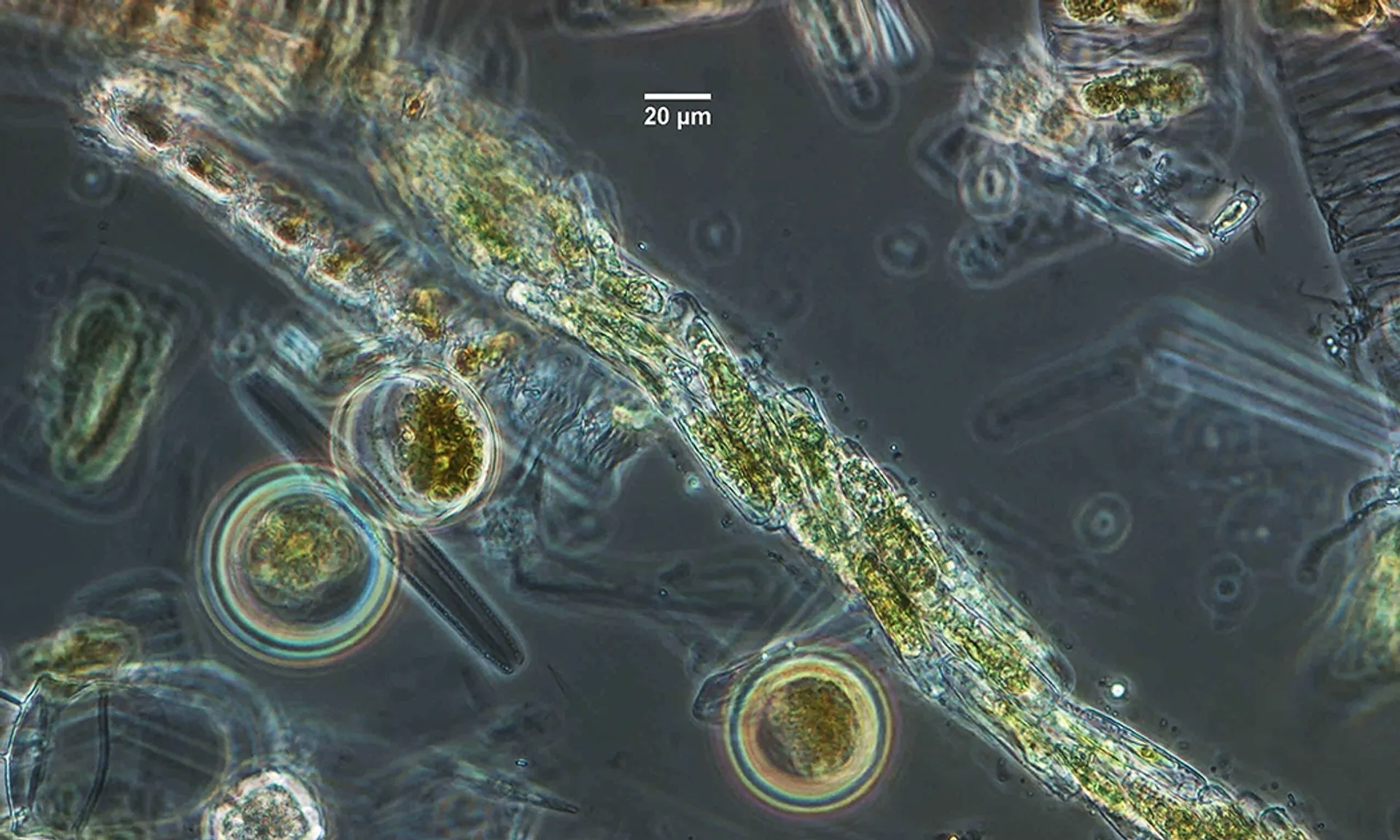
Picture: Algae under the microscope. Credit: Megan Lenss.
Exploring texture and algae
Megan also tests a deeper hypothesis: does the texture of the ice—its internal microstructure—affect algal growth?
“I have this hypothesis that the texture must impact the algae,” she says. “Texture affects things like pore size, and pore size affects how much seawater gets into the ice, how nutrients cycle, and how much space sea-ice algae have to live.”
Unfortunately, the study can’t confirm the hypothesis. All the sampled sea-ice cores contained platelet ice, so there was no control group for comparison.
“The takeaway is kind of like—probably—but it’s really hard to say just from this,” Megan says. “It’s a nice hypothesis that remains unsolved here. Further research is required.”
Why sea-ice algae matter
For something so small, sea-ice algae have a big impact. They are the foundation of the Antarctic food chain. “They are a really important food source for Antarctic krill,” Megan explains. “And krill is the keystone species of the Southern Ocean and the animal with the largest biomass on the entire planet.”
That matters to more than just penguins and whales. The Southern Ocean plays an outsized role in global carbon storage. Estimates suggest it is responsible for up to 40% of the ocean’s carbon dioxide uptake. While most of that is due to physical processes, about 10% comes from primary producers like algae.
“Sea-ice algae are key part of that larger story,” Megan says.
A story just beginning
This research began as part of Megan’s master’s thesis. While she didn’t go on the cruise herself—COVID restrictions meant samples had to be collected by technical staff—she and her colleagues did all the lab analysis at the Norwegian Polar Institute.
She is now continuing her PhD with UiT’s laboratory for sea Ice Biome research (iSI-Bio), working on key scientific questions on primary production in the Southern Ocean sea-ice zone.
She is also participating in ecosystem monitoring and human impact mapping to support proposed future marine protected areas in the Southern Ocean.
“Marine conservation is something I’m really interested in,” she says. “But there are still a lot of questions that need to be answered before these proposals can go forward.”
In the meantime, her work is helping to fill key gaps in our understanding of Antarctic sea ice, and what happens to the tiny organisms that live there. The implications, both ecological and climatic, are profound.
“This was a really fun paper to write,” Megan says. “It is cool. And it is the first time we are able to publish this kind of data from this region.”
Learn more
The study has been featured in the Polar Journal: "Tiny but globally significant – What algae beneath sea ice reveal about climate and food webs". Read it here.
The full paper, “Incorporated platelet ice layers provide refuge for sea-ice algae in the Kong Håkon VII Hav”, is published in Marine Ecology Progress Series and is available here.
Megan Lenss is a PhD researcher with the Norwegian Polar Institute and UiT’s Department of Arctic and Marine Biology. She is affiliated with iC3 Polar Research Hub. You can learn more about her research here.
Megan’s work is funded by the iC3-affiliated I-CRYME and WOBEC projects via Sebastian Moreau (NPI & iC3) and Karley Cambell (UiT, AMB). The sea-ice cores were collected during the 2022 Transect Cruise. A list of over two dozen iC3-affiliated polar science projects is available here