Interview: "Understanding the manganese and iron cycles in the Antarctic sediments could improve our understanding of the carbon cycle"
November 2nd, 2026
In this interview, iC3 PhD student Sam Sidders explains how iron and manganese released from East Antarctic sediments influence marine ecosystems and carbon cycling, her past research, as well as her interest outside science.
Can you briefly describe yourself and the focus of your research?
My name is Sam Sidders, I am a PhD student at the University of Pennsylvania and affiliated with the iC3 Polar Research Hub. My current research focuses on polar regions and the biogeochemical cycling of macro- and micronutrients under climate change. In particular, I am studying how iron and manganese are released from marine sediments on the East Antarctic continental shelf.
Previously, I studied geosciences and classical studies at Williams College, then worked as a postgraduate research associate at Yale on enhanced weathering, a carbon dioxide removal strategy.

Credit: Isabella Frank and Emma Lindbergh.
Why is studying iron and manganese cycling in the Southern Ocean important?
It is important because iron and manganese are micronutrients that are essential for phytoplankton growth in the Southern Ocean. Phytoplankton support the marine food web and contribute to carbon export, so understanding how these nutrients are released from sediments can improve our knowledge of carbon cycling and the region’s role in the climate system. The East Antarctic shelf is also poorly studied compared with regions such as the West Antarctic Peninsula, so collecting these measurements during the upcoming iC3 cruise in Antarctica will help fill an important gap in our understanding.
What experiments will you conduct during the cruise?
We will collect sediment cores using a multicore system. From one core, I will extract pore water with rhizon samplers shortly after recovery. These measurements will provide information about diagenetic processes and allow us to calculate potential diffusive fluxes of micronutrients.
A second core will be incubated onboard at approximately 4°C. I am developing an airtight cap that allows repeated sampling while keeping the overlying water mixed without resuspending the sediment. We plan to take eight samples over 72 hours. I am designing the system in collaboration with the Penn machine shop and using 3D-printed components. Through the incubations, we will measure benthic fluxes of micronutrients, macronutrients, and organic and inorganic carbon. Before the cruise, we will test our cap and stirring system to ensure the equipment does not introduce metals into the samples.
Could your results be used in modelling?
Yes. We could combine our measurements with datasets from other Antarctic shelf regions and environmental variables such as sea-ice cover and bottom-water oxygen concentrations. A machine-learning or random-forest model could identify the main controls on micronutrient fluxes and help extrapolate results beyond our limited sampling sites. These estimates could eventually be incorporated into larger models of nutrient and carbon cycling in the ocean.
Which technologies are you most excited to use in your research?
On the cruise, I’m very excited to test the sediment core incubation system that we are designing. Back on land, I look forward to running our samples on the ICP-MS/MS to quantify iron and manganese concentrations—the instrument can be temperamental, but it is a fun challenge, and the data will be critical for the project.
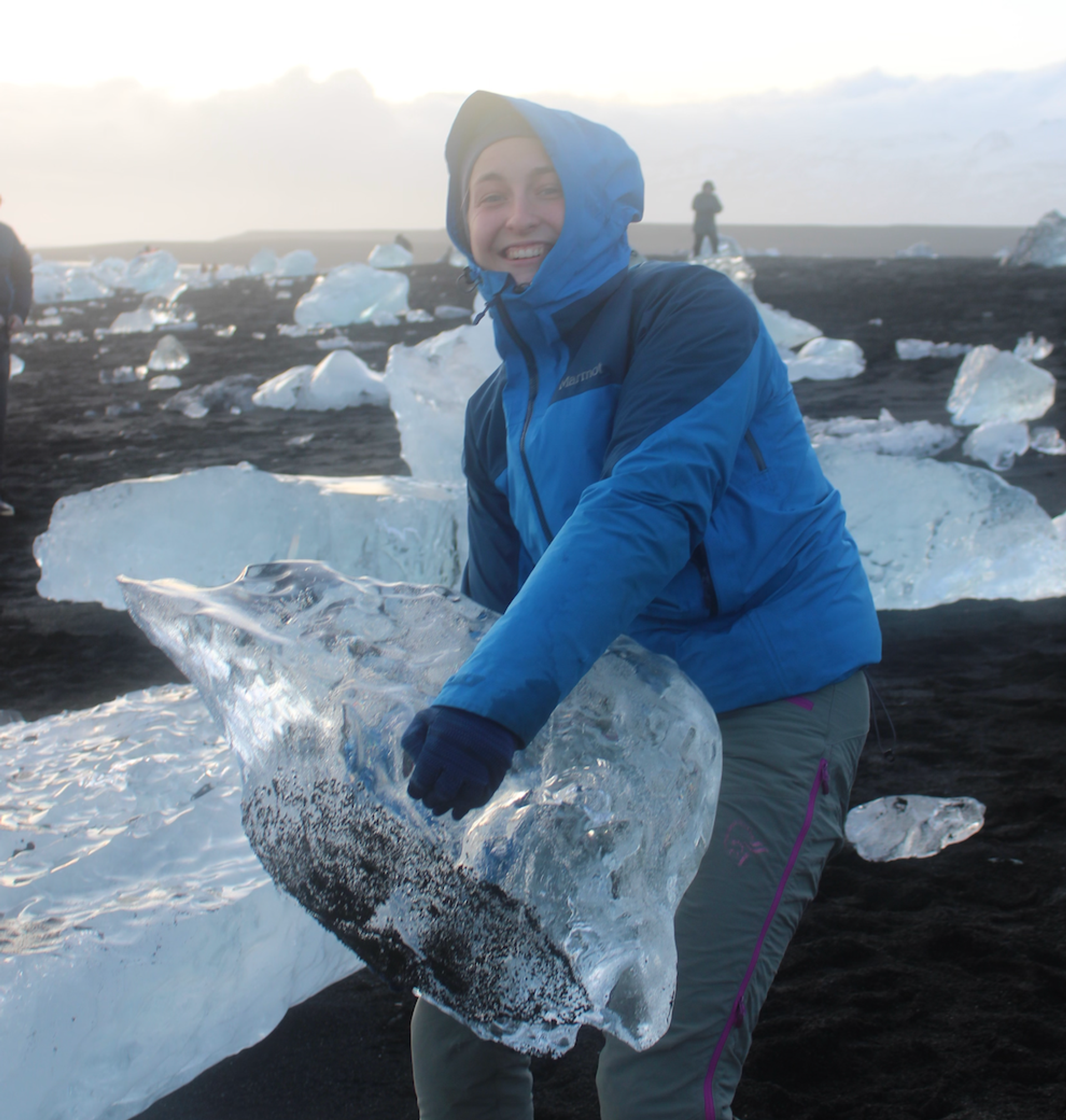
Credit: Sam Sidders.
What was your undergraduate research on nitrogen recycling at subduction zones?
I investigated how much nitrogen is transported into Earth’s deep interior at subduction zones and how much returns to the atmosphere through volcanic gases. The prevailing theory is that the thermal state of a subduction zone controls nitrogen recycling, with hotter slabs expected to release more nitrogen.
I compared sediment inputs from Cascadia, considered one of the hottest subduction zones, and Kamchatka, a relatively cold one. At Kamchatka, I used updated gas-geochemistry and satellite sulphur-dioxide data to calculate revised nitrogen outputs. My results suggest that almost no nitrogen is retained in the slab, contrasting with earlier estimates that over 90% is retained. This implies that thermal state may not be the primary control on nitrogen release from the slab.
What does an ideal day off look like for you?
I enjoy spending lots of time outside, whether that be going on a jog through Philadelphia, hiking outside of the city, or going on a long walk while calling my grandmother. I also love to cook, particularly baking muffins and cookies for my friends and family. Lastly, I enjoy reading for fun outside of work, including for the book club I have with my friends from high school—I’m currently reading The Count of Monte Christo.
Do you have a personal motto?
My motto is that there is no such thing as wasted time. I used to worry about choosing the most efficient path, taking every opportunity and avoiding decisions that might slow me down. I have come to believe that every experience provides skills and knowledge that can be useful later, even if it does not seem directly connected to my goals.
Samantha Sidders is a PhD student at the University of Pennsylvania and affiliated with the iC3 Polar Research Hub. Within iC3, she is part Research Unit 2: Methane, nutrients and carbon. To find out more about her work, contact her by email or via LinkedIn.