Interview: "Microbes play a critical role in either mitigating or amplifying carbon emissions from the ground to the atmosphere"
May 28th, 2026
In this interview, iC3 researcher Dimitri Kalenitchenko discusses his work on microbial ecology, focusing on microbes' role in the carbon cycle and their impact on greenhouse gas emissions in extreme environments.
Can you briefly describe yourself and the focus of your research at iC3?
My name is Dimitri Kalenitchenko, and I am a microbiologist working at iC3 in the UiT Arctic University of Norway and the University of La Rochelle (France). At iC3, my research focusses on how microbes interact with their environment and their role in the carbon cycle. Over the past three years, I’ve studied microbes living under ice and how these environments influence the carbon cycle, particularly greenhouse gases like methane and CO2.
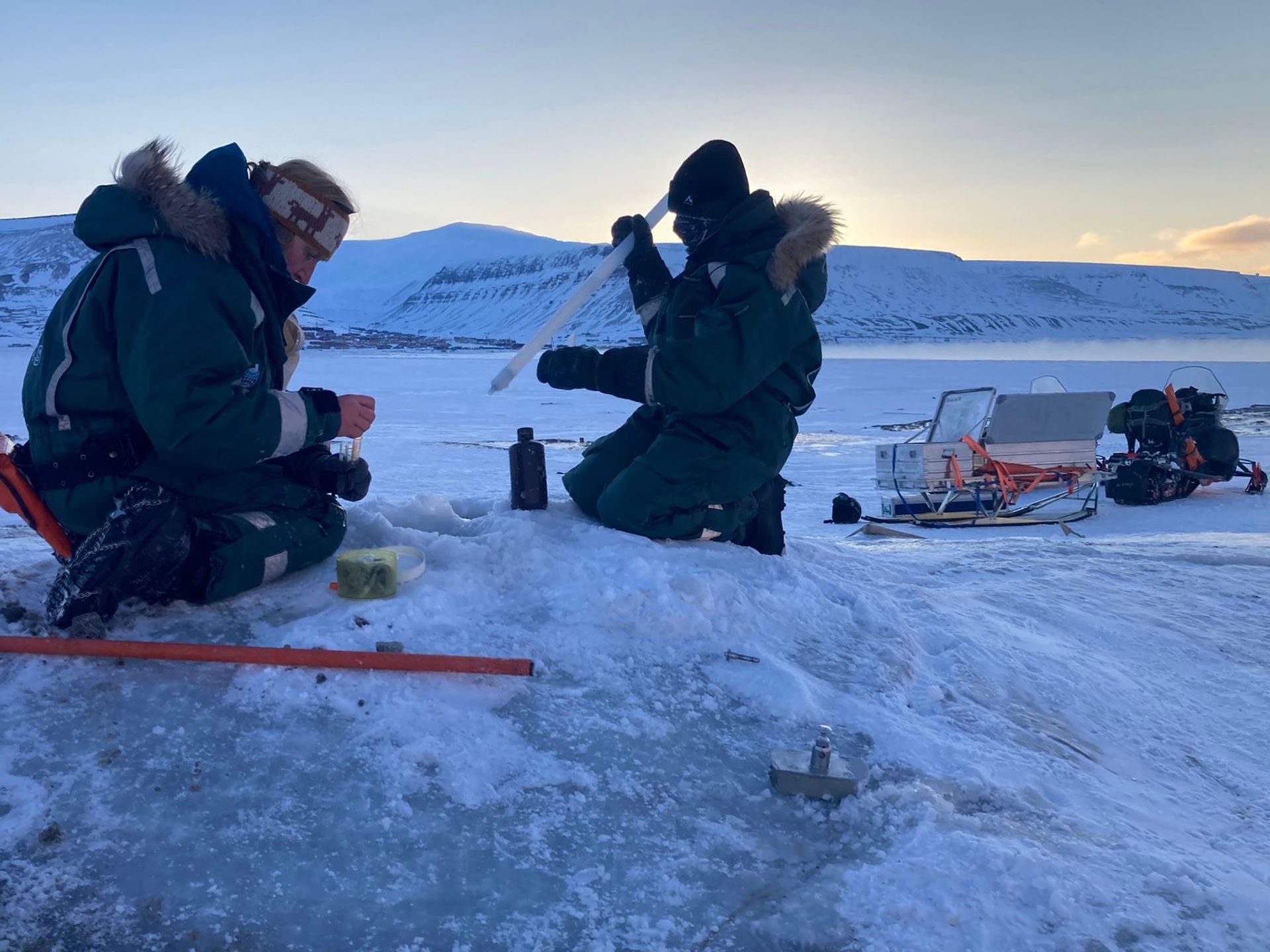
Credit: Dimitri Kalenitchenko
Why is it important to study these microbes?
Greenhouse gas emissions are often assessed as net fluxes, but I’m interested in understanding the processes behind these fluxes. Microbes play a critical role in either mitigating or amplifying carbon emissions from the ground to the atmosphere. My research focuses on environments affected by climate change, such as the Arctic. For instance, rising temperatures in Svalbard will impact these ecosystems. I hope my work will eventually help modelers predict how microbial processes will evolve with ongoing climate change.
How are you studying these microbes exactly?
My routine involves spending most of the year in the office, working with PhD students and planning projects. Eventually, I go into the field to deploy sensors and collect samples. I combine in situ (field-based) and ex situ (lab-based) approaches, bringing the lab to the environment and vice versa. This dual approach helps me better understand the processes I study.

Picture: Greenhouse Gas floating chamber in front of a glacier. Credit: Dimitri Kalenitchenko
Could you give a concrete example of an application of your research?
One of our recent field projects called GLACIGAS, funded by the research council of Norway took place in a fjord in Svalbard, where we worked with a multidisciplinary team of Norwegian and French researchers from La Rochelle University. We mapped a previously unexplored fjord with a retreating glacier. We discovered methane gas sources seeping from the seabed, which could potentially form future cold seeps. This work highlights the connection between retreating glaciers and greenhouse gas emissions, aligning with iC3’s goal of understanding carbon sources.
How did you come to work at the UiT and be affiliated with iC3?
My training was in oceanography, and after my PhD in France, I worked in Canada studying planktonic communities under ice. I then joined the Centre of Excellence CAGE at UiT to study gas hydrates. During this time, I realized that using research vessels limited my ability to study dynamic processes, as access to sites was infrequent. I started looking for analog systems and found uplifted marine sediments in Svalbard that were ideal for studying methane seepage. This led to the iC3 affiliated METHANICE project, which combined geology and biology. iC3 later aligned perfectly with my work, allowing me to expand my research further.
What technologies or methodologies are you most excited about in your field?
I’m particularly excited about remote sensing technologies. For decades, biology-related sensors were limited to measuring photosynthesis, like chlorophyll A. Now, we’re seeing advancements in sensors that can detect greenhouse gases like methane and carbon dioxide, even from satellites. Some instruments can even measure isotopes in the field.
What are some of the biggest challenges you’ve faced in your research?
Interdisciplinarity is both a challenge and a strength. As a microbial ecologist, I rely on geologists, geochemists, and other specialists to understand the systems I study. However, we often work on different scales—microbial processes occur on a micro or mesoscale, while geologists focus on macroscale systems. This can lead to conflicting priorities during fieldwork. Bridging these gaps requires a deep understanding of other disciplines, which takes time and effort.
Could you describe a memorable moment or breakthrough in your research?
During the METHANICE project, we deployed a CTD probe under ice in Svalbard, designed to operate autonomously for a year. When we returned to retrieve it, I was thrilled to find it still functioning and recording data. Seeing the sensor alive and receiving a feed of data was incredibly rewarding, especially given the challenges of deploying such equipment in extreme environments.
What qualities and skills are you looking for in a postdoc or collaborator?
The main thing I look for is problem-solving skills. I want someone who can approach a problem creatively, use their knowledge, and not be afraid to make mistakes. It’s important to be proactive and not get stuck in a loop when facing challenges. This ability to tackle problems head-on is the top quality I value.
If you could change one thing in science, what would it be?
I would change the emphasis on quantity over quality in scientific publishing. The sheer volume of publications makes it difficult to keep up, and careers are often judged by the number of papers rather than their impact. I hope the system shifts to prioritize high-quality, interdisciplinary research that addresses significant questions rather than producing descriptive papers for the sake of numbers.

Picture: Lagoon pingo monitoring station. Credit: Dimitri Kalenitchenko
Could you share a book or a movie that has significantly influenced you?
I’m a big fan of Back to the Future. It’s a movie that shaped my vision of a scientist—someone working in their garage, building something that pushes global knowledge forward. It also shows how scientific discoveries can have both positive and unintended consequences.
What’s one thing you’re looking forward to in the next year, either personally or professionally?
Personally and professionally, I’d love the opportunity to go to Antarctica. It’s a dream destination for me, both as a researcher and as someone fascinated by extreme environments. Antarctica’s massive glacial systems offer incredible opportunities to study the processes I’m interested in, like how carbon is trapped and released. It’s also a place I’ve always wanted to visit since childhood.
Do you have any final thoughts or a personal motto you would like to share?
Science is definitely a challenging career path, but it’s important to trust yourself and find your own way. While mentors and collaborators are there to help, you should strive to become independent and confident in your abilities. If you ever feel too dependent on someone scientifically, it might be time to move on and carve out your own path. Trust in yourself is key to growing as a scientist.
Dimitri Kalenitchenko is a researcher at the the Department of Geosciences at UiT The Arctic University of Norway and associate professor at the University of La Rochelle (France). His research focuses on microbial ecology, exploring how microorganisms interact with their environment and influence the global carbon cycle. He is particularly interested in remote sensing and sensors that can detect greenhouse gases like methane and CO2.