Interview: "Reconstructing the past of the Arctic Ocean is critical for understanding the global climate system"
February 23rd, 2026
In this interview iC3 researcher Jochen Knies explains his work on reconstructing the Arctic's climate history, the methodologies involved, and the importance of understanding past cryosphere-carbon feedbacks to inform future climate predictions.
Could you briefly describe yourself, the focus of your research, and how it relates to iC3?
My name is Jochen Knies, I am an iC3 researcher in the Department of Geosciences at the UiT Arctic University of Norway, and at The Geological Survey of Norway (NGU). My research focuses on reconstructing the past of the Arctic Ocean, including the surrounding shelf areas. I’ve been working on this for about 30 years.
I've got a leading role in the iC3-affiliated European Research Council (ERC) Synergy project i2B Into the Blue: Resolving past Arctic greenhouse climates.
Within iC3, I’m particularly interested in processes related to methane escape from the seafloor and carbon burial in marine sediments, but I approach it from a paleo perspective. I work with deep-time records, such as the Holocene, deglaciation periods, or even the Miocene.
Recently, I’ve been studying Triassic-Jurassic hothouse climates to understand how the Arctic evolved over time.
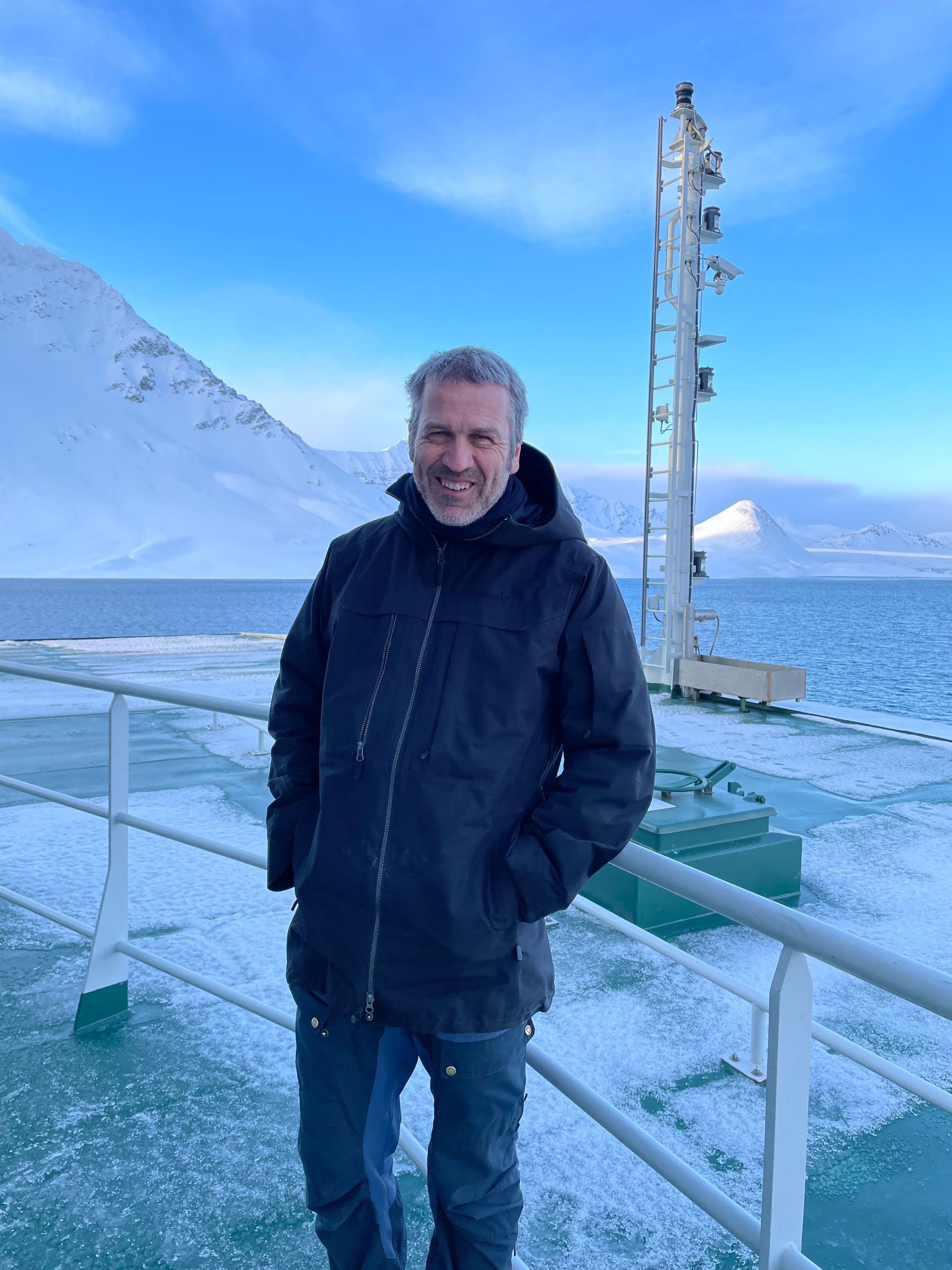
Credit: Jochen Knies
Why is it important to study the Arctic’s past?
The Arctic is critical for understanding global systems. It’s a region that plays a key role in climate regulation, and its history provides insights into how the Earth has responded to past climate changes.
However, studying the Arctic is challenging due to environmental constraints like ice coverage, which requires icebreakers, and the limitations of available methods.
Many researchers stop where it gets icy because it becomes methodologically complex, but being at iC3 gives me access to infrastructure and opportunities to address these challenges.
How do you conduct this research?
I mainly guide early-career researchers who do the hands-on work.
First, we establish an age model for sediment cores using methods like radiocarbon dating, paleomagnetism, stable isotopes, and radionuclides. Combining these methods is essential because each has limitations.
Once we have an age model, we apply proxies to infer environmental parameters like temperature, sea ice, and glacial evolution. It’s a time-consuming process, often taking years to complete.
What methodologies excite you the most in your field?
I’m a geologist at heart, so I enjoy working directly with sediment – examining grain sizes, colors, and structures. However, I’ve also explored geochemistry, biomarkers, stable isotopes, and radionuclides.
The most intriguing aspect for me is stratigraphy, as it combines multiple disciplines to create a comprehensive picture of the past. It’s a complex but fascinating process that requires integrating micro-paleontology, paleomagnetism, and other methods.
Before iC3 and i2B, you were part of a previous research centre at the university. What did you do there?
During my time at CAGE, I focused on methane-related processes, particularly gas hydrates and methane emissions in the Arctic. My role involved building competence in this area, collaborating with geophysicists, geochemists, and marine geologists.
We conducted fieldwork, analyzed carbonate crusts, and explored the implications of methane release on climate systems. While methane is still a focus for iC3, my current work emphasizes paleo perspectives and past climate reconstructions.
What qualities and skills do you look for in a postdoc or collaborator?
The most important quality is enthusiasm for the field. I want to work with people who are genuinely passionate about their research and bring their own ideas to the table.
While I guide and mentor PhDs and master’s students, I expect postdocs to be more independent and proactive. It’s not just about producing papers, it’s about being dedicated to the task and contributing meaningfully to the project.
Have you always aspired to have this career?
Yes, I’ve wanted to be a polar scientist since I was young. My passion was solidified when I spent several months on Svalbard at the age of 21, living in a cabin and later in a tent. That experience inspired me to pursue a career in Arctic research, and I’ve been dedicated to it ever since.
What are some of the biggest challenges in your research, and how do you overcome them?
One of the biggest challenges is managing my own expectations. I set high standards for myself, and I often extend those expectations to others.
However, I’ve learned that not everyone operates the same way, and I can’t expect others to meet the same level of intensity or output. To overcome this, I focus on performing to the best of my ability and leading by example. I try to create an environment where others feel motivated but not pressured.
Could you describe a memorable moment or breakthrough in your research?
Securing the i2B project was a significant achievement for me. I had applied multiple times with the same concept and team, only to face rejection.
When it was finally approved, it was an emotional moment. It was a turning point in my career, as it allowed me to lead a large-scale project and make a meaningful impact in Arctic science.
What’s one thing you would change in science?
I would reform the peer review process. It’s currently exploitative, with researchers reviewing papers for free while publishers profit.
The process should be more transparent and fairer, with proper recognition for reviewers. This would improve the quality of science and make the system more equitable.
What does an ideal day off look like for you?
An ideal day off starts with a relaxed breakfast on Saturdays, which is a sacred ritual in my family. I enjoy spending time outdoors, whether it’s skiing in the winter or hiking in the summer.
I also appreciate cultural activities like visiting galleries, attending operas, or listening to public discussions. It’s about finding a balance between relaxation and engagement.
Do you have a personal motto or final thoughts to share?
Dedication and enthusiasm are key. I often find that people lack engagement and curiosity in meetings or discussions.
My advice to anyone entering this field is to be passionate and committed. Ask questions, share ideas, and immerse yourself in the science. It’s this level of engagement that drives progress and makes the work truly rewarding.
Jochen Knies is a researcher in the Department of Geosciences at UiT The Arctic University of Norway and at The Geological Survey of Norway (NGU). His research focuses on reconstructing the past of the Arctic Ocean. He is particularly interested in stratigraphy, combining multiple disciplines such as micro-paleontology, paleomagnetism, and other methods to create a comprehensive picture of the past.