Interview:" I combine hydrate modelling with biogeochemical models to estimate the fate of emitted methane and potential effects on ocean acidification"
October 1st, 2026
In this interview, iC3 postdoc Maria De La Fuente explains how methane hydrates may affect the climate, shares insights from her research in Svalbard and the Southern Ocean and discusses her work as a science communicator and Climate Pact Ambassador.
Can you briefly describe yourself and the focus of your research?
My name is Maria De La Fuente, I am an MSCA postdoctoral researcher at iC3 fascinated by the oceans and climate awareness. My work sits at the interface of both: I model processes at the seafloor and their consequences for the carbon cycle. Specifically, I study how methane hydrates beneath the seafloor, and in permafrost, respond to warming and their own internal dynamics. When hydrates dissociate, they can release methane, so I investigate how much is emitted and whether it remains methane or is transformed into other forms of carbon in the ocean and atmosphere.

Credit: Adam Ward.
Why is methane important in climate research?
Methane is a powerful greenhouse gas. It stays in the atmosphere for roughly a decade before it is oxidised into CO₂, but during that time it has a much stronger warming effect than CO₂. Methane released from the seafloor may also be transformed by chemical reactions and microbes in the ocean. These processes can affect ocean chemistry, including acidification, and ecosystem functioning. Understanding them is therefore important for predicting future climate and environmental impacts.
What region does your current project focus on?
My project focuses on the western margin of the Svalbard archipelago, particularly along the Vestnesa Ridge. This area has a long history of documented methane seepage, making it an ideal natural laboratory for studying Arctic seafloor methane seepage.
Along the ridge, different geological settings create different pathways for methane, from rapid flow through fractures to slower movement through the sediments, affecting how methane travels through the seafloor and therefore how much is consumed before reaching the ocean.
Some fractured and folded areas show persistent seepage, while others have more diffuse emissions and carbonate-rich environments. This helps us investigate how methane moves through the seafloor and how microbes use it to form carbonate deposits.
How do you study these processes?
I use a numerical model developed at GEOMAR that can represent the internal dynamics of methane hydrates. This is important because hydrates can become unstable even without direct changes in pressure or temperature, something older steady-state models may miss. I combine hydrate modelling with biogeochemical models to estimate the fate of emitted methane, including its conversion to CO₂ and potential effects on ocean acidification. Because Svalbard is well monitored, I can compare model results with observations and test whether the models reproduce reality.
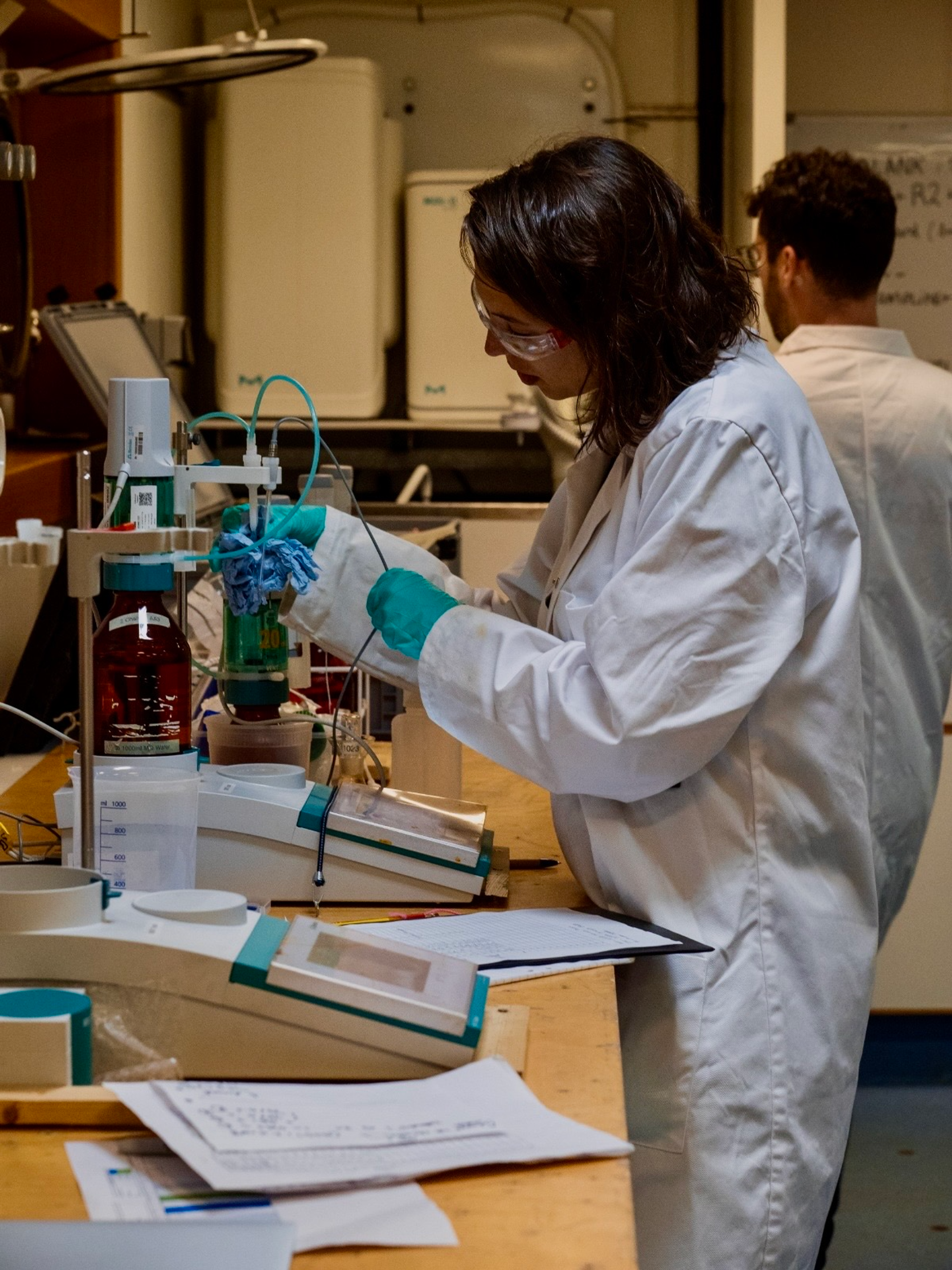
Credit: Adam Ward.
What have been important moments in your research?
A particularly memorable moment was discovering 113 clusters of methane flares during a hydrate expedition in the Southern Ocean. These active seepage sites had not been observed there before, opening new questions about hydrate stability in the region. I have also crossed the Drake Passage twice and participated in Atlantic campaigns studying climate-driven changes in ocean biogeochemistry and circulation.
Where do you see yourself after this position?
Ideally, I would lead my own interdisciplinary research team focused on methane. Through my platform, Methane Matters by Maria, I want to highlight that methane deserves greater attention in climate research. I would like to bring together researchers studying methane storage in hydrates, methane transport through sediments and water, microbial methane consumption, and its effects on climate. The goal would be to understand where methane matters most and how it affects our remaining opportunities to limit climate change.
You are also a climate ambassador and science communicator. What does it mean?
As a Climate Pact Ambassador, I help connect science, society and policymaking. I want people to understand that climate change is not only about the atmosphere: the ocean and seafloor play crucial roles too. My goal is to communicate complex science in a factual but accessible way, often using metaphors.
I am active on social media, give talks, visit schools and write a climate column for a newspaper. I also have my own website. I like communicating as a person rather than only as “a scientist,” because people may connect more easily with science when they see the human behind it.
What do you enjoy outside work?
I am very sporty. I enjoy hiking when possible, going to the gym, joining exercise classes and dancing. I also like cooking, writing and spending time with the people I care about. I am currently writing a book, To Reconnect, which will help non-scientists make sense of climate change and the concepts often discussed in the media.
Do you have a motto?
Yes, my motto is: “If your why is strong enough, you will always find your how.” I believe that if you have strong values and a clear purpose, you can find ways to move forward while staying true to them.
Maria De La Fuente is an MSCA postdoc working at the iC3 Polar Research Hub, based in the Department of Geosciences at the UiT Arctic University of Norway, Tromsø. She is part of iC3 Research Unit 5: Future climate and oceans and Research Unit 4: Impact of past changes in ice. To find out more about her work, please check out her list of publications, her website, or contact her by email or via LinkedIn.